North Carolina Concealed Carry FAQ: 25 Questions Students Ask Us
North Carolina issues a concealed handgun permit through your county sheriff to residents who are at least 21, complete an approved firearms safety course and pass a background check. The permit lasts five years, costs about $90, and lets you carry a concealed handgun statewide except in places the law specifically prohibits. Below are the 25 questions we hear most often from students in our Elm City classroom, answered plainly with the statute numbers you can look up yourself.
Laws change — this page was last reviewed October 2026 and is general information, not legal advice. For the full picture, start with our guide to North Carolina concealed carry laws.
Eligibility and the permit
1. Who can get a North Carolina concealed handgun permit?
G.S. 14-415.12(a) says the sheriff shall issue a permit to an applicant who is a U.S. citizen or lawful permanent resident, has lived in North Carolina for at least 30 days, is 21 or older, has no physical or mental condition that prevents safe handling of a handgun, and has completed an approved firearms safety and training course. Subsection (b) then lists the disqualifiers: anyone prohibited from possessing a firearm under state or federal law, felony convictions or pending felony charges, fugitives, unlawful drug users, certain mental health adjudications, dishonorable discharges, specified violent misdemeanors within the last three years, and an impaired-driving conviction within the last three years.
2. Does a DWI disqualify me?
A conviction under G.S. 20-138.1, 20-138.2 or 20-138.3 within three years before you apply is a disqualifier under 14-415.12(b)(11). Older convictions are not, but be honest on the application. Lying on it is its own problem.
3. How much does the permit cost?
G.S. 14-415.19 sets the application fee at $80, the renewal fee at $75 and a duplicate at $15, plus a fingerprint fee of up to $10. In practice Wilson, Pitt, Wake and Edgecombe counties all charge $90 for a new permit. Our class tuition is separate; current pricing is on the registration page.
4. How long does it take to get the permit?
Once the sheriff has your complete application, fingerprints, fee and release forms, G.S. 14-415.15 gives the sheriff 45 days to issue or deny, with that clock also depending on receipt of your mental health records. Some offices are faster. Add the time it takes to get an appointment, which varies a lot by county.
5. Do I apply with the state or the county?
The county. You apply to the sheriff of the county where you live. Most eastern NC sheriffs, including Wilson, Nash, Edgecombe, Pitt and Wake, now start the application online through a permit portal and then have you come in for fingerprints and documents.
6. Can a non-resident get a North Carolina permit?
No. The 30-day residency requirement in 14-415.12(a)(1) means North Carolina does not issue non-resident permits. If you live in another state, get that state’s permit; North Carolina will honor it (see question 15).
7. I am in the military stationed in North Carolina. Can I apply?
Yes, once you have lived here 30 days, and you apply in the county where you reside. Military service does not by itself exempt you from the training course; the exemptions in G.S. 14-415.12A are for sworn and retired law enforcement, certain correctional and probation officers, and registered armed security guards. One benefit the law does give deployed service members: under 14-415.11(a), a permit that expires during deployment stays valid for up to 90 days after the deployment ends if you can show proof of deployment.
The class
8. What does the concealed carry class involve?
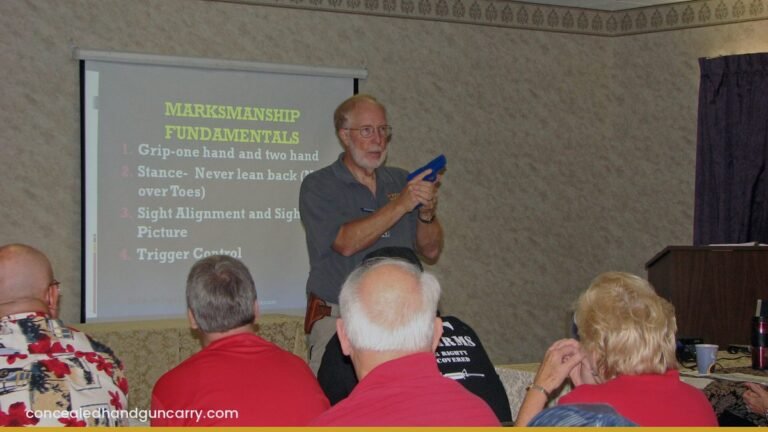
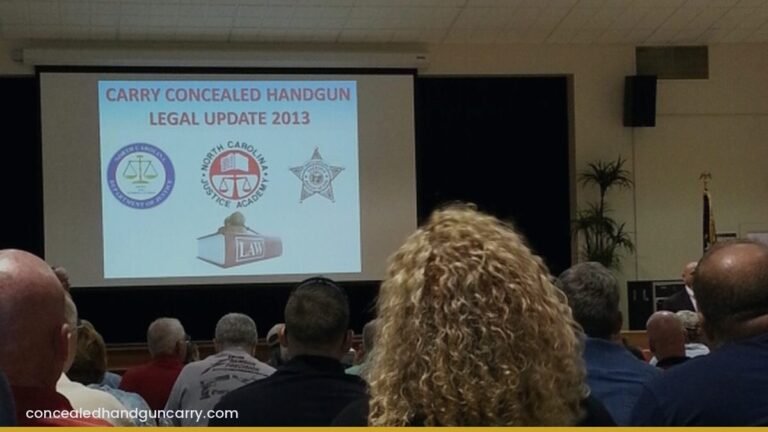
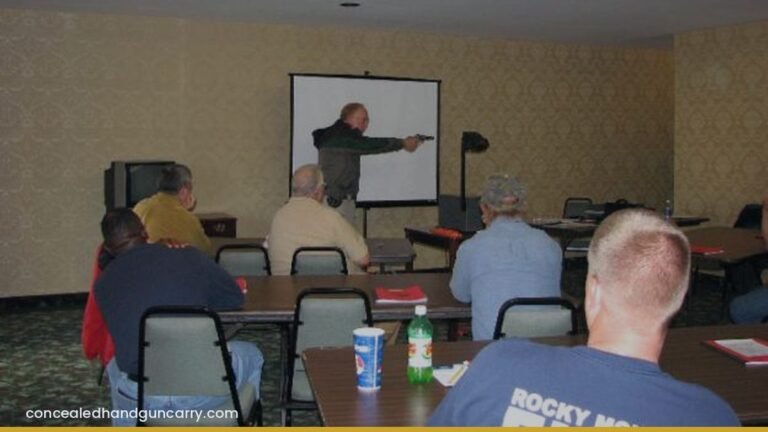
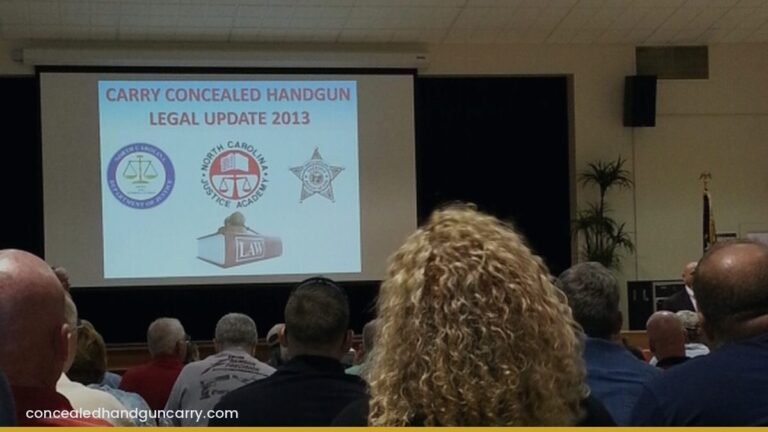
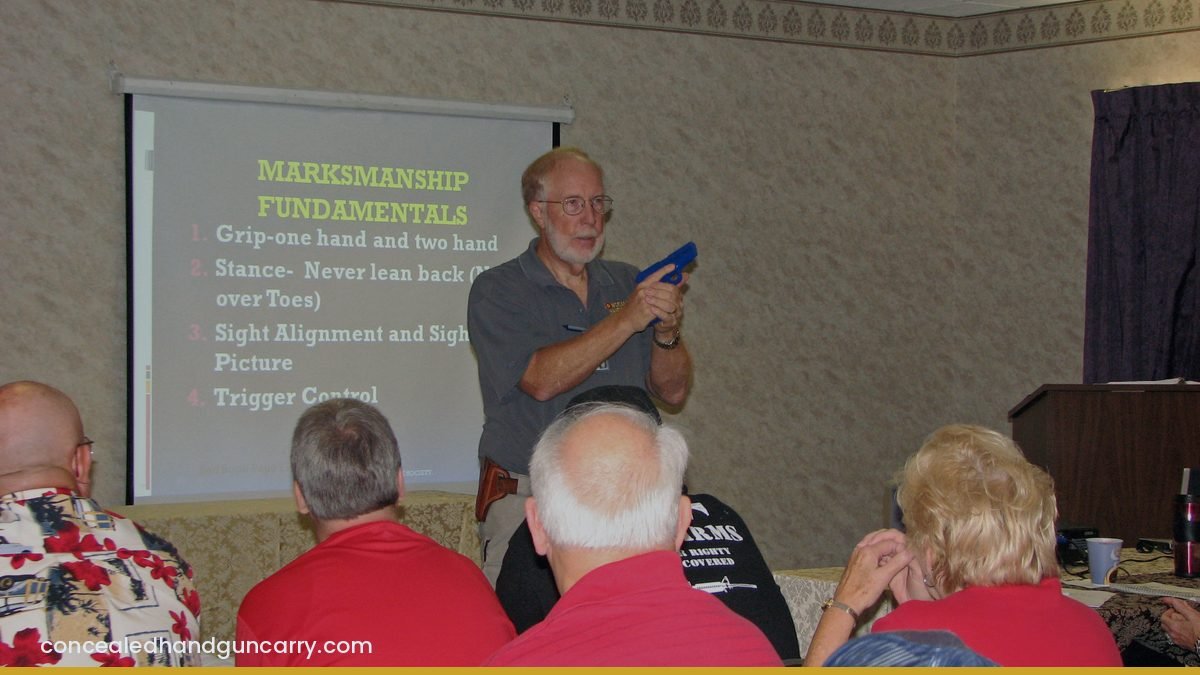
The state-approved curriculum is a full day, a minimum of eight hours, covering handgun safety and handling, North Carolina law on carrying and on the use of deadly force, and a live-fire qualification. In our classes we spend more time on the law than most students expect, because the legal part is what keeps you out of trouble. Details are on the NC Concealed Handgun Carry class page.
9. Do I need to own a gun to take the class?
No. You need a handgun for the range portion, and we can help students who do not yet own one. Call ahead so we can plan for it.
10. How hard is the shooting qualification?
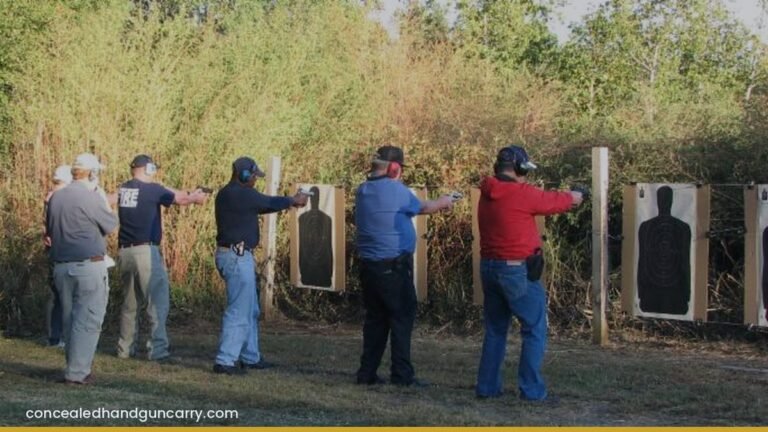
It is a basic marksmanship test at close distance, not a tactical course. Most students pass it with the instruction they receive that day. If you are nervous about shooting, our women’s handgun class or a private lesson before the course is a good warm-up.
11. How long is the training certificate good for?
The statute does not put an expiration date on the certificate, but individual sheriffs may have policies about how old a certificate they will accept. Our advice: apply within a few weeks of finishing the class.
Carrying day to day
12. Do I have to tell an officer I am carrying?
Yes. G.S. 14-415.11(a) requires you to carry the permit and valid ID whenever you carry, to disclose both the permit and the handgun when an officer approaches or addresses you, and to show them on request. Failing to do so is an infraction under 14-415.21(a). We cover how to say it calmly in our article on carrying in your car.
13. Where can I not carry?
Schools (G.S. 14-269.2), courthouses and the State Capitol complex (14-269.4), state and federal office buildings, law enforcement and correctional facilities, parades and demonstrations (14-277.2), places posted against concealed handguns, and anywhere federal law prohibits (14-415.11(c)). The full list, with the exceptions, is in where you cannot carry concealed in North Carolina.
14. Can I carry in a restaurant that serves alcohol?
Yes, with your permit, unless the establishment has posted a notice prohibiting it (G.S. 14-269.3(b)(5)). But 14-415.11(c2) makes it unlawful to carry while consuming alcohol or while any alcohol remains in your body. Order the sweet tea.
15. Which states honor my North Carolina permit?
Roughly three dozen states recognize an NC resident permit, and North Carolina recognizes every other state’s permit under G.S. 14-415.24. The exact list shifts, so check the NC DOJ reciprocity page and the destination state before every trip. We keep a current summary in North Carolina concealed carry reciprocity.
16. Can I carry in my car without a permit?
Not concealed. G.S. 14-269(a1) makes it unlawful to carry a concealed pistol off your own premises without a permit, and North Carolina courts have treated a hidden handgun within reach of the driver as carried about the person. Without a permit, keep it in plain view or locked in the trunk or a locked compartment. With a permit, you may carry it concealed on your body or in the vehicle.
17. Can I carry at church?
State law does not list places of worship as prohibited. A church can post against concealed carry like any private property. If the church shares property with a school, G.S. 14-269.2(k1) allows a permit holder to carry outside school operating hours or inside the worship building during services, as long as the property is not posted.
18. Can my employer stop me from carrying at work?
Yes. An employer controls its premises and can post a notice under 14-415.11(c)(8) or simply make it a condition of employment. Carrying past a conspicuous posting is an infraction; violating a policy can cost you your job.
19. Does the permit let me carry a knife or other weapon?
No. The permit covers handguns only. G.S. 14-269(a) still applies to other concealed weapons.
20. What is the penalty for carrying concealed without a permit?
A first offense under 14-269(a1) is a Class 2 misdemeanor; a second or later offense is a Class H felony. That felony would also end your ability to own firearms.
Renewals, moves and life changes
21. When and how do I renew?
Apply within the 90 days before expiration (G.S. 14-415.16). You submit a renewal form, an affidavit that you remain qualified, fingerprints if required and the $75 fee. The sheriff may waive the training course for a timely renewal. Our step-by-step renewal guide walks through it.
22. What if my permit already expired?
You cannot legally carry concealed on an expired permit. If you apply within 60 days after expiration the sheriff may still waive the course (14-415.16(e)); after that, expect to start over as a new applicant including the class.
23. I moved. What do I have to do?
Notify the sheriff who issued the permit of a permanent address change within 30 days (14-415.11(d)). Update your driver’s license first. Your permit remains valid statewide after an in-state move.
24. I lost my permit. Now what?
Report it to the issuing sheriff and apply for a duplicate with a notarized statement that the original was lost or destroyed and the $15 fee (14-415.11(d), 14-415.19).
25. Do I need more training after I get the permit?
Legally, no. Practically, the permit class is a floor, not a ceiling. Students who go on to our defensive shooting class or the After Deadly Force seminar consistently tell us those courses changed how they carry.
Bottom line
Getting the North Carolina permit is straightforward if you meet the requirements: take an approved class, apply to your sheriff, wait for the background check. Carrying well afterward takes a little more effort, and that is what we try to give you in a day. If you are ready to start, register for the next NC Concealed Handgun Carry class in Elm City.
Frequently asked questions
How old do you have to be to get a concealed carry permit in North Carolina?
You must be at least 21 years old under G.S. 14-415.12(a)(2). You also have to be a U.S. citizen or lawful permanent resident and have lived in North Carolina for at least 30 days before applying.
How much does a North Carolina concealed handgun permit cost?
The statutory application fee is $80 plus up to $10 for fingerprinting, so most sheriffs charge $90 for a new permit. Renewals are $75 and a duplicate is $15 under G.S. 14-415.19. Class tuition is separate.
Does North Carolina have constitutional carry?
No. As of October 2026 a permit is still required to carry a concealed handgun in North Carolina. A permitless-carry bill (SB 50) passed in 2025 but was vetoed, and the House has not voted to override the veto.
Do I have to tell a police officer I am carrying?
Yes. G.S. 14-415.11(a) requires a permit holder to disclose the permit and the handgun whenever a law enforcement officer approaches or addresses you, and to show the permit and photo ID on request.
Can I carry concealed in a restaurant that serves alcohol in NC?
A permit holder may carry in a restaurant or bar unless the owner has posted a conspicuous notice prohibiting it, but you may not consume alcohol or have any alcohol in your body while carrying under G.S. 14-415.11(c2).
How long is a North Carolina concealed handgun permit good for?
Five years from the date of issue under G.S. 14-415.11(b). You should apply to renew within the 90 days before it expires.
Does North Carolina honor out-of-state concealed carry permits?
Yes. Under G.S. 14-415.24 a valid concealed handgun permit issued by any other state is valid in North Carolina. The visitor still has to follow North Carolina's rules on where and how to carry.