Concealed Carry Positions: The Clock Guide From 12 to 6 O’Clock
Concealed carry positions are described with a clock face drawn around your waist: 12 o’clock is your belt buckle, 3 o’clock is your right hip, 6 o’clock is your spine, and 9 o’clock is your left hip. Right-handed carriers mostly choose between appendix at 1 to 2 o’clock and strong side at 3 to 4 o’clock, and we discourage 5 to 6 o’clock, the small of the back, for reasons laid out below. This page walks around the clock, explains who each position suits, and ends with a table you can use to narrow your own choice.
It is one of the detailed pages behind our guide to how to choose a concealed carry holster; every page in the series is listed in the concealed carry holster guide.
How the clock system works
Stand up, look down at your belt and imagine the face of a clock lying flat on it with 12 at the buckle. Every position around your waist is a number on that clock. The system is handed: everything below is written for a right-handed shooter, and a left-handed shooter mirrors it (3 o’clock becomes 9 o’clock, 1 o’clock becomes 11 o’clock). The clock describes where the holster sits, not how it sits: ride height, cant (the forward or backward tilt of the grip) and inside versus outside the waistband are separate decisions covered in IWB vs OWB holsters.
Around the clock, position by position
12 o’clock: centerline
Directly behind the belt buckle. It works for very slim people and almost nobody else; the grip presses into the stomach when seated and the muzzle points straight down the centerline of the body. Most people who try 12 o’clock end up drifting to 1 o’clock within a week.
1 to 2 o’clock: appendix (AIWB)
Forward of the hip bone, in the hollow between the hip and the lower abdomen. This is the fastest draw most people can learn, the gun conceals well standing and seated, and both hands can defend it. The muzzle covers the femoral artery and groin when holstered, which means re-holstering is slow, looked-at and done leaning slightly back, and it demands a rigid holster with a wedge. Comfort seated depends on your build and the gun’s length. We do not start new carriers here. The whole subject, including who should wait, is in the appendix carry guide.
2 to 3 o’clock: forward of the hip
Between appendix and strong side, on the front edge of the hip bone. Some people land here because it is more comfortable than true appendix when seated while still being reachable from the front. The problem is the hip bone itself: the holster rides on top of it, which is uncomfortable, and the grip tends to print at the front of the hip where the shirt is pulled tight. It is a compromise position that suits a few builds well.
3 to 4 o’clock: strong side
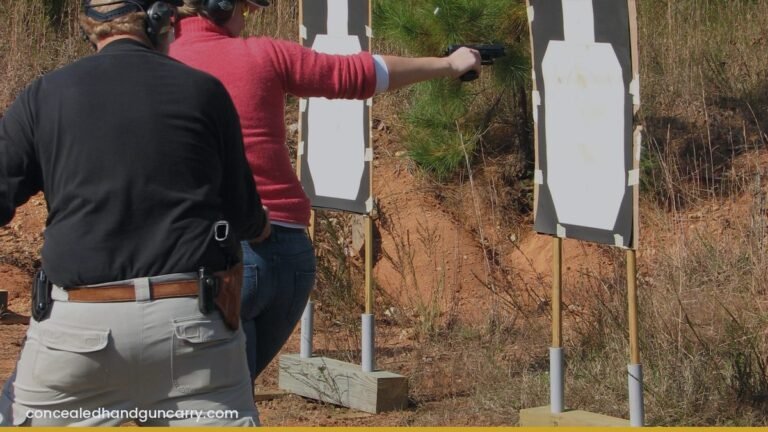
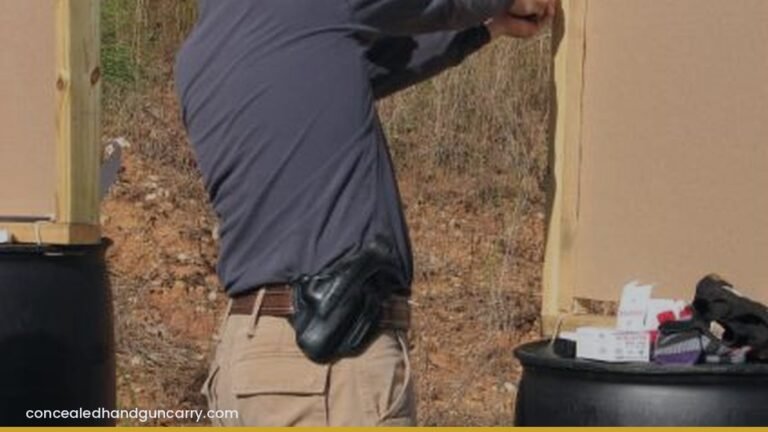
The point of the hip and just behind it. This is the traditional concealed carry position and the one we start most students in. The draw is natural — the hand drops to the side and the gun comes straight up — and the muzzle points at the ground through the entire stroke, which makes it the most forgiving position to learn on. At 3 o’clock the gun sits right on the hip bone, which is comfortable for some and not for others. At 3:30 to 4 o’clock it moves behind the hip into the curve of the back, where it conceals better and sits away from the bone. The cost of moving back is that the grip prints when you bend forward and the gun is harder to protect from someone behind you. Most of our students who carry IWB settle somewhere between 3:30 and 4.
4 to 5 o’clock: behind the hip
Further back, approaching the kidney. Concealment standing is excellent because the gun is in the deepest curve of the back. Everything else gets worse: the draw requires the shoulder to rotate back, the gun is pinned when seated, and the grip is now behind you where you cannot see or defend it. For people with a larger midsection, 4 o’clock is often the most comfortable belt position available and it is a reasonable choice; past 4:30 the drawbacks of small-of-back carry begin to apply.
5 to 6 o’clock: small of back, and why we discourage it
Centered on the spine or just to the strong side of it. It conceals well standing up, which is why people choose it, and that is the only thing in its favor. Our objections:
- You cannot see the holster. Re-holstering is blind by definition, in violation of the rule we care about most.
- The draw sweeps you. Depending on holster orientation, the muzzle crosses your own back and side, and anyone standing behind you, on the way out.
- Falls. If you go down backward — a shove, ice, a fight — you land with your spine on a steel object. People have been seriously injured this way.
- Seated access is poor. In a car or a restaurant booth, the gun is behind you against a seat back.
- Weapon retention is poor. The gun is where an attacker behind you can reach it and you cannot see it.
If you want the gun that far back for comfort, 4 o’clock gets you most of the concealment with far fewer problems.
Cross draw: 10 to 11 o’clock for a right-handed shooter
The holster sits on the support side, forward of the hip, with the grip pointing toward the strong hand, and the draw comes across the body. It gives good seated access, which is why it has a long history with drivers and people who sit at a desk all day. The costs: the muzzle sweeps everything to your support side during the draw, including anyone standing there; the grip points forward where someone facing you can grab it; and the gun is slower to bring onto a target in front of you than a strong-side draw. Many ranges, including ours, restrict or prohibit cross-draw holsters on the firing line for the sweep problem alone. It has a place for some people and some situations, and it needs specific training.
Left-handed carriers, women and off-belt carry
Left-handed carriers
Everything above mirrors. Strong side is 8 to 9 o’clock, appendix is 10 to 11 o’clock, cross draw is 1 to 2 o’clock. Two practical notes. First, a right-handed holster worn on the left side is not a left-handed holster: the cant goes the wrong way, the sweat guard is on the wrong side and the clip pulls away from the body. Buy a true left-handed model. Second, the muzzle direction concerns of cross draw and appendix are unchanged; they just point the other way. In class we position left-handed students on the end of the line for exactly that reason.
Sitting and driving
How a position behaves seated matters more than most people think, because most of us sit for most of the day. Appendix gives the best seated access and is the easiest to reach with a seat belt on. Cross draw is second. Strong side at 3 to 4 o’clock is reachable but the seat belt and the seat bolster both get in the way; practice the seated draw with an unloaded gun, buckled in, in your own car before you count on it. Anything behind 4:30 is effectively inaccessible in a car. North Carolina has specific rules about carrying in a vehicle and about what you must tell an officer at a traffic stop, and they are covered in concealed carry in your car in North Carolina.
Women and carry positions
Women’s clothing and body proportions change the clock. A higher natural waist puts a belt holster against the ribs when seated; a more pronounced hip angle tilts a strong-side holster outward so the grip prints; and many women’s pants have no belt loops worth the name. Appendix often works well standing and poorly seated; 4 o’clock often works well seated and prints when bending. The answer is usually a different ride height, a different cant and sometimes a different carry method entirely. We go through all of it in concealed carry holsters for women.
Off the belt
Pocket, ankle, shoulder and belly band holsters are not clock positions, but they are where some people end up when no belt position works with their job or clothes. Each has specific safety and access problems, and each is covered in pocket, ankle, shoulder and belly band holsters.
Positions compared
| Position (right-handed) | Pros | Cons | Who it suits |
|---|---|---|---|
| 12 o’clock centerline | Conceals on very slim builds | Grip into stomach seated; muzzle on centerline | Very few people |
| 1–2 o’clock appendix | Fastest draw; conceals standing and seated; both hands defend it; best in a car | Muzzle covers femoral artery; unforgiving re-holster; seated comfort varies | Trained carriers, slimmer builds |
| 2–3 o’clock forward of hip | Reachable from the front; better seated than appendix | Rides on the hip bone; grip prints at the front | A few builds |
| 3–4 o’clock strong side | Natural draw; muzzle at the ground throughout; easy to learn; conceals well at 3:30–4 | Prints bending forward; pinned by seat belt | Most new carriers; most builds |
| 4–5 o’clock behind hip | Excellent standing concealment; comfortable for larger midsections | Harder draw; poor seated access; gun behind you | Larger builds who stand most of the day |
| 5–6 o’clock small of back | Conceals standing | Blind re-holster; draw sweeps you; spinal injury in a fall; poor retention and seated access | We do not recommend it |
| 10–11 o’clock cross draw | Good seated access; works with a desk or a steering wheel | Sweeps support side on the draw; grip exposed to a grab; often restricted on ranges | Drivers and desk workers with specific training |
How to choose
Start at 3:30 to 4 o’clock unless you have a reason not to. Carry an unloaded gun there for a day, sit in your car, sit at your desk, bend and reach. If it prints when you bend, try 3 o’clock. If it digs into the hip bone, try 4. If you are slim and spend your days driving, consider appendix after instruction. Give any position a month before you judge it. And whatever position you pick, draw from it dry until it is boring, then live, under supervision, before you trust it; the NC Concealed Handgun Carry class is the first place most of our students draw from a holster at all, and it shows.
Bottom line
The clock tells you where the gun is; your body, your clothes and your day tell you where it should be. Strong side for most people starting out, appendix for those who train for it, nothing behind 4:30 if we can talk you out of it. If you would like an instructor to watch you draw from the position you have chosen and tell you honestly whether it works, our defensive shooting class is built for exactly that.
Frequently asked questions
What does 3 o'clock carry mean?
Picture a clock face around your waist with 12 at the belt buckle and 6 at the spine. For a right-handed shooter, 3 o'clock is the point of the right hip, and 3 to 4 o'clock is the traditional strong-side carry position.
What is the most comfortable concealed carry position?
For most people it is 3:30 to 4 o'clock, just behind the hip, where the gun sits in the natural curve of the body and does not dig in when seated. Appendix is comfortable for slimmer builds standing but harder when sitting.
Why is small-of-back carry discouraged?
You cannot see the holster, the draw sweeps your own body and anyone behind you, the gun is easy to take from behind, and a backward fall lands your spine on a steel object. Access while seated or driving is also poor.
Where should left-handed shooters carry?
Mirror the right-handed positions: 9 to 8 o'clock for strong side, 11 to 10 o'clock for appendix. Make sure the holster is a true left-handed model, not a right-handed holster worn backward.
What is the best carry position for driving?
Appendix gives the best seated access, with cross draw second. Strong-side hip carry works but is pinned by the seat belt; practice drawing seated and unbuckled with an unloaded gun before relying on it.