Concealed Carry Holsters for Women: What Actually Works
Most concealed carry holsters are designed around a man’s frame: a long, fairly straight torso, a waistline that sits above the hips, and pants with belt loops. Women who carry run into a different set of problems — the holster rides on a curve instead of a flat, the grip prints or digs into the ribs, and much of the clothing has no belt at all. The fixes are practical: a different ride height and cant, a wedge, a belly band for athletic wear, and honest decisions about when off-body carry is worth its risks. This page covers what we see work in class and what we see fail.
Read it alongside the pillar on how to choose a concealed carry holster; the four non-negotiables there (trigger guard covered, retention, consistent position, safe re-holstering) apply exactly the same way here. The holster guide hub lists every page in this series.
Body-shape realities, without the stereotypes
This is not about one body type. It is about a few measurable differences that change how a belt holster behaves:
- Shorter torso. Less distance between the belt line and the bottom of the ribs. A full-size grip on a standard-cant holster ends up jammed under the ribs when you sit, and the top of the slide pushes the holster outward when you bend.
- Hip curve. On a straighter frame the belt is roughly vertical at 3 to 4 o’clock. On a curved waist the belt tilts inward above the hip, so the holster tilts with it and the grip angles away from the body. That is the single biggest cause of printing we see with women’s setups.
- Waistband height. Low-rise and mid-rise pants put the belt line below the natural waist, which lengthens the distance the gun has to travel to clear the holster and often puts the muzzle end against the thigh when seated.
- Clothing construction. Thinner fabrics, closer fits, leggings and dresses. The gun has fewer places to hide, and many outfits have nothing to attach a holster to.
None of this makes on-body carry impossible. It means the default setup that works for a man straight out of the box usually needs adjustment, and it means some women will find a different position works better.
On-body options that work
Appendix carry with a wedge
Appendix inside the waistband (AIWB) at 12 to 1 o’clock avoids the hip curve entirely. The gun sits on the flat of the lower abdomen, so there is no tilt, and a shorter torso is less of a problem because the grip has room above it. The piece that makes it work is a foam wedge attached to the back of the holster near the muzzle. The wedge pushes the muzzle out and rotates the grip in toward the body, which both conceals the grip and takes pressure off the pelvis when sitting. Many women tell us AIWB with a wedge is the first setup that was comfortable in a car. The method has a real safety requirement around re-holstering, which we cover in detail in the appendix carry guide, and we want students to learn it under supervision before carrying that way.
Strong side at 3 to 4 o’clock with a high ride
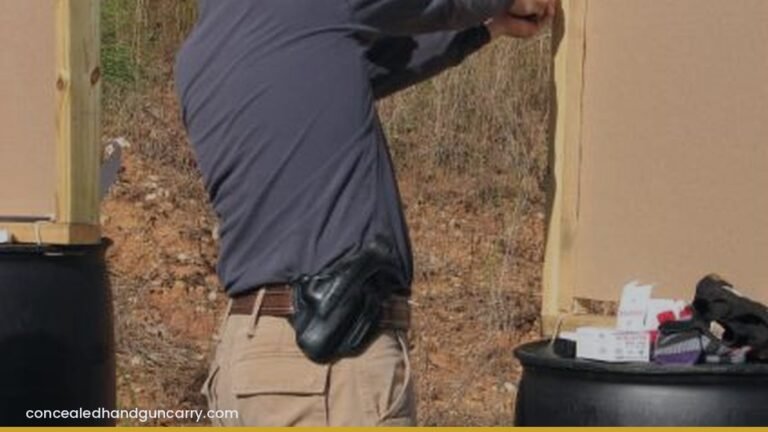
If appendix does not suit you, the strong-side hip still works with two changes. First, raise the ride height so the trigger guard sits at or just above the belt line; this lifts the muzzle end off the hip bone. Second, add forward cant (15 to 20 degrees is common) so the grip rolls forward and up instead of pointing out from the curve of the hip. A single wide belt clip or two clips spaced apart keeps the holster from rotating on the belt. If the grip still prints, moving to 4 o’clock often helps because the gun tucks into the hollow behind the hip. Our clock guide to carry positions explains each spot.
Belly band for athletic wear and dresses
Leggings, running shorts, scrubs, dresses and skirts have no belt, and that is where an elastic belly band comes in. Worn at the waist or high on the hips under the top layer, a band holds the gun against the body with no belt loops required. Two rules: the band must have a rigid holster or trigger-guard shield built into it, not just an elastic pocket, and you need to accept that retention and draw speed are both weaker than a belt holster. We go through the strengths and weaknesses of bands in our page on pocket, ankle, shoulder and belly band holsters.
Other options students use
Some women carry a small pistol in a dedicated pocket holster in a jacket or cargo pocket, and some use a thigh band under a skirt. Both are slow and both require strict discipline about keeping anything else out of that pocket or band. We would rather see one of the three methods above when the clothing allows it.
Off-body and purse carry: when it is acceptable
We are not going to tell you purse carry is never acceptable. For a woman in a dress at a wedding or a professional who cannot carry on-body at work in any practical way, a purpose-built bag can be the difference between carrying and not carrying. But it has to be understood as the compromise it is.
The risks are not theoretical:
- Access. A gun in a purse is two or three seconds slower to reach than a belt holster, and in a purse snatch the attacker takes your gun with your wallet.
- Children. A bag set on a counter, a chair or a car seat is a bag a child can open. In our classes, the parents and grandparents in the room understand this immediately. If children are ever in your home or car, off-body carry needs the gun locked or on your person without exception.
- Theft and loss. Bags get left in restaurants, in shopping carts and in vehicles. Every one of those is a stolen gun waiting to happen.
- Trigger access. Keys, pens and lipstick tubes end up in the same compartment as the gun. That compartment has to hold a holster that covers the trigger guard, and nothing else goes in it.
If you carry off-body, the rules we teach are: a dedicated compartment with a holster secured inside it, the bag worn cross-body and never set down in public, the same bag and same compartment every time, and regular practice drawing from it with an unloaded gun. If you cannot commit to those four, carry on-body or leave the gun at home.
Clothing strategies that make on-body carry easier
| Problem | What tends to work |
|---|---|
| Fitted tops that show the grip | Patterned or darker fabric, a layer such as a cardigan or open shirt, or a slightly looser cut in the hip area only |
| Low-rise pants | Mid- or high-rise pants with real belt loops; the belt line moves up and the holster stops sitting on the thigh |
| No belt loops at all | A belly band, or a holster made for a waistband with a built-in clip that grabs the fabric |
| Dress or skirt | A belly band worn high, a thigh band for a small gun, or a dedicated holstered bag worn cross-body |
| Thin summer fabric | A smaller or thinner gun, a wedge to roll the grip in, and a top with some structure at the hem |
The gun belt matters as much for women as for men, and a wide, stiff belt is often harder to find in women’s sizes. If your pants have loops, a proper belt fixes more printing and sag than any holster swap will; see our page on how to stop printing for the full list of causes and fixes.
What Dianne teaches in our G-A-L-S class
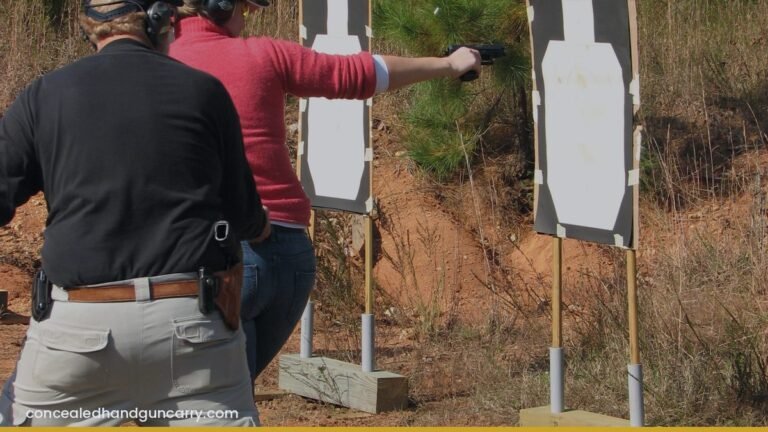
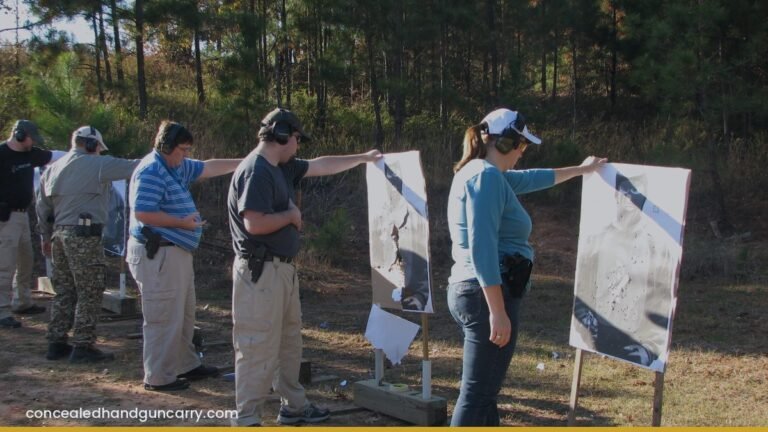
Our G-A-L-S women’s handgun class is taught by Dianne Raper, and holsters are part of the curriculum rather than an afterthought. Students bring the gun and holster they plan to carry, and the class works through fit on the body, ride height and cant adjustments, the wedge, the belly band, and a supervised draw from concealment with an unloaded gun before anyone goes to the line. Dianne also covers the purse question honestly, including the handling habits that make off-body carry safer for women who choose it. The most common outcome we see is a student who arrives carrying off-body and leaves with a workable on-body setup she did not think was possible.
Many students take the women’s class before or after the NC Concealed Handgun Carry class that qualifies them for the permit. Either order works.
Bottom line
Women’s carry problems are mostly geometry problems: the holster was built for a different torso and hip, and the clothing has fewer places to hide a gun. Appendix with a wedge, a high-ride strong-side holster with cant, and a belly band for athletic wear solve most of them on-body, and purse carry is a last resort with rules attached. If you want to work through your own setup with an instructor, register for Dianne’s next women’s class and bring the holster you intend to carry.
Frequently asked questions
What is the best holster position for women?
There is no single answer, but the two we see work most often are appendix carry with a foam wedge and a strong-side IWB holster at 3 to 4 o'clock with a high ride height and a slight forward cant. Which one wins depends on torso length, hip shape and how you dress.
Is purse carry a bad idea?
It is a compromise with real risks: slower access, a bag that can be snatched or set down, and children who can reach inside. If you must carry off-body, use a bag with a dedicated holstered compartment and never let the bag leave your body.
Can I carry in leggings or athletic wear?
Yes, with a belly band or a dedicated holster built for a waistband without belt loops. Insist on a rigid trigger-guard cover inside the band, and expect the draw to be slower than from a belt holster.
Why does my holster dig into my hip bone?
Most holsters are molded and canted for a longer, straighter torso. When the belt sits at the narrowest part of a curved waist, the holster tilts and the grip or muzzle end presses into the hip or ribs. Raising the ride height, adding cant or moving the holster forward usually fixes it.
Do I need a smaller gun because I am a woman?
No. Hand size, recoil tolerance and how much gun you can conceal all matter, but they are individual, not a matter of sex. Many women shoot a compact better than a micro pistol. Pick the gun you can run well, then build the carry setup around it.
Does your women's class cover holsters?
Yes. Our G-A-L-S women's handgun class, taught by Dianne Raper, spends time on carry methods, holster fit and drawing from concealment, and students are encouraged to bring the holster they intend to carry.